
Welcome to May We Gather - Week 1
I'm so glad you joined.
Our first meeting is on Wednesday, May 6th at 3pm at Christ Church — 431 Union Street, Hudson. This is intended to be “field work” to be done prior to that meeting. It is optional — but will help you deepen your relationship to the material.
You’re here because you’re in transition — you’re letting go of what was and making room for what will be. It sounds simple, but it’s not simple work. It’s uncomfortable. You might be grieving. Feeling disoriented. Struggling to concentrate. You might be struggling to make meaning out of everyday life. You might feel like you’re caught between selves, like you’ve finished something — or started something new — before you were ready.
Whatever brought you here: I see you. And I want you to know that what you're feeling makes complete sense.
Our culture is pretty bad at transitions. We're good at marking the obvious ones — weddings, funerals, graduations — but even then, the ceremony ends and we're expected to move on. We don't make a lot of room for the messy, slow, disorienting in-between that follows a change, or for the invisible transitions that don't come with a party or a ritual at all.
So many of us have been taught, implicitly or explicitly, to just get on with it. To not dwell. To look on the bright side. To be grateful it wasn't worse.
This group is a gentle, stubborn act of resistance against all of that.
What Is a Transition, Actually?
There’s a lot out there written about these liminal, transitory moments. The framework I’ve found the most useful was developed by William Bridges and Susan Bridges. They make an important distinction between change and transition:
A change is the external event: the job ends, the baby arrives, the diagnosis happens, the relationship shifts, the house sells.
A transition is the internal process associated with the change. They define it as "the process of letting go of the way things used to be and then taking hold of the way they subsequently become."
That gap between letting go and taking hold? That's where we're living. And it takes time to move through a transition — often more time than the world allows us (or that we allow ourselves!).
Researchers have found that one of the most disorienting things about major life changes is what's sometimes called identity paralysis — the inability to release a previous identity and move into a new one. This happens even in cases where the change itself was chosen and wanted. This isn’t something to judge yourself for — it’s actually your nervous system doing its job. It’s trying to make sense of who you are now that the landscape around you has shifted. It’s protecting you. And it sometimes works on overdrive, stepping in when you don’t need it to. So much of what we’ll do together will be to tune into our own bodies, to down-regulate our nervous systems, so we can sit with what’s there and move from a place of choice.
Transitions change the shape our days, our lives, and most importantly, our sense of self. They unravel our understanding of who we are — so that something new has room to emerge. That unraveling is the work. It’s sacred work, and we’re doing it together.
The Bridges Transition Model
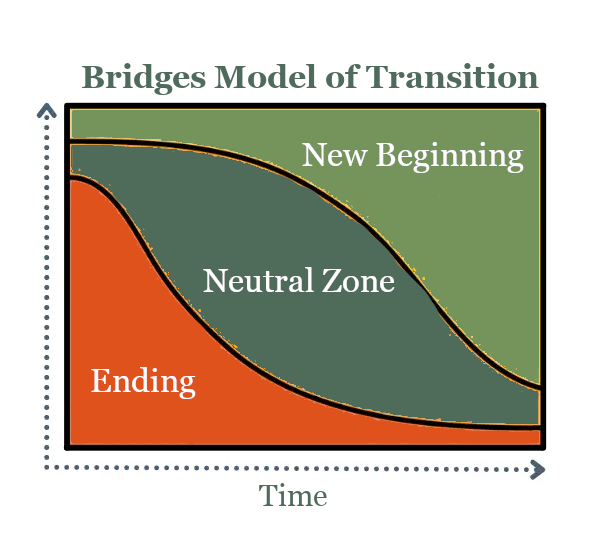
We're going to use the Bridges Transition Model as a kind of map for our time together. Maps help you figure out where you are so you feel a little less lost.
The model has three stages — and here's the counterintuitive thing: they're not linear. You're probably in all three at once, in some proportion. You might feel like you’re making progress one day, and then find yourself feeling like you’re back at the start the very next day.
The Ending
Something shifts — a door closes, a chapter ends — and you register it. The ending isn't always dramatic. Sometimes it's quiet, maybe even seemingly minor. But it signals that a cycle is closing. At the same time, even in the ending, the seeds of something new are already present — even if you can't see them yet.
The Ending asks: What am I leaving behind? What needs to be honored or grieved before I can move forward?
The Neutral Zone
This is the liminal space — the in-between. The old is releasing its hold and the new hasn't arrived yet. You might feel disoriented here, groundless, uncertain of who you are or what you want. The neutral zone often gets a bad reputation because it’s the most uncomfortable. We want to rush through it. But it's actually where the most important transformation happens. It's where we're becoming.
Research on major life transitions consistently finds that people who allow themselves to fully inhabit the neutral zone — rather than rushing to resolve it — tend to integrate change more deeply and emerge with a clearer sense of self and direction. The neutral zone is not the problem. It's the point.
The Neutral Zone asks: What am I releasing? Who am I becoming? What wants to emerge?
The New Beginning
The new beginning takes shape — slowly, then often all at once. This isn't a clean arrival; you're still in conversation with the neutral zone, still metabolizing the ending. But something is building. There's momentum where there wasn't before. You catch yourself imagining what your future can hold instead of ruminating in what has been.
The New Beginning asks: What am I moving toward? What new story is taking shape?
How We Navigate This Together
In our time together, we’ll be focusing on the evidence-based practices that best help people navigate transitions.
Reflection with witness. Each live session, we’ll do timed shared to reflect with witnesses on what we’re navigating. Writing also helps us process — we’ll do this in between sessions to help shape our understanding of our own experiences. I encourage you to bring what comes up into our live sessions.
Honoring your emotions through your body. Transitions live in the body. Grief isn’t only in your head — it can be weight in the chest, a thickness in the throat. Each week, we'll drop in somatically, checking in with where we are physically. There is wisdom in our bodies!
Ritual. We'll do live rituals together during each of our four sessions. These will be intentional acts that mark what's happening and signal to your nervous system: this matters, I'm paying attention.
Time and space to process alone. Each week, you'll receive a guided meditation to use between sessions. I'll also offer writing prompts you can sit with on your own. Transitions need solitude alongside community.
Welcoming your resistance. You will resist some of this. That resistance is information, not failure. Notice it. Name it in our group. Welcome it in. It usually means you're close to something real.
Crafting a story that ties past and present together. Each week, there's a short form on this page for you to fill out. You can also do this in a journal, if you prefer — but if you DO fill it out in the form, I'll compile your responses and give them back to you at the end of our time together as a narrative of your own arc.
A Few Definitions
Transition: The internal psychological process of adapting to change — distinct from the external change event itself. A transition begins with an ending and ends with a new beginning, with a liminal "neutral zone" in between.
Ritual: A ritual is simply any intentional act done with awareness and meaning. That's it. It doesn't have to be elaborate or spiritual or inherited from a tradition. Lighting a candle before you sit down to write is a ritual. Taking three deep breaths before you walk into a hard conversation is a ritual. A ritual is just a way of saying: I'm here. This matters. I'm paying attention. We've been doing this as humans for as long as we've been human — and there's actually solid research showing that ritual behaviors reduce anxiety and increase our sense of agency during uncertain times.
Altar: An altar is a dedicated physical space where you place objects that carry meaning. It's not a religious requirement — it's a human one. Across cultures and millennia, people have gathered meaningful objects together in one place as a way of externalizing what's internal: what we're grieving, what we're honoring, what we're calling in. For our time together, I encourage you to build a simple altar at home — a windowsill, a corner of your dresser, a small tray. A photo, a stone, a candle, something from nature. Something that belongs to what you're leaving. Something that belongs to what you're moving toward. We'll have a shared altar in our in-person sessions too.
Somatic: "Somatic" simply means "of the body." When we do somatic work, we're turning our attention inward — noticing physical sensation, breath, posture, tension, ease — rather than staying up in our heads with our thoughts. Most of us have been trained to process experience almost entirely cognitively: we think about what happened, we analyze how we feel, we make sense of it with language. Somatic practice asks us to slow down and check in with the body first, because the body often knows things the mind hasn't caught up to yet. Each time we gather, we'll begin with a centering practice that I'll guide you through — a chance to arrive fully, drop out of the mental chatter, and feel where you actually are.
Nervous system: Your nervous system is your body's internal communication network — the biological infrastructure that registers experience and coordinates your responses to the world. Here's what matters for our work together: your nervous system doesn't distinguish very well between physical danger and emotional upheaval. A major life transition — even a chosen, wanted one — can activate the same stress responses as an actual threat. That's why transitions feel so physically exhausting. That's why you might find yourself snapping at people you love, lying awake at 3am, or feeling numb. That's your nervous system working hard to process. The good news is that the nervous system is also where healing happens. A lot of what we'll do together — the somatic check-ins, the ritual, the being witnessed — is, underneath everything else, nervous system care.
Thank you for being here. Thank you for trusting me — and this group — to hold this with you.
Somatic Centering Tutorial
Each week, we'll begin our sessions by centering together. This is a tutorial of how I approach that practice. We center in three dimensions — length, width, and depth — as a map back to yourself, using physical sensation to anchor dignity, connection, and a sense of your own journey through time. From that located place, we'll make room to feel what you're longing for, then close with a simple mood check. This is an optional exercise to try ahead of our first session — and an excellent way to be with yourself fully before a journaling exercise, a tough conversation, or any moment where you want to be acting from your whole self, not just your busy mind.