Welcome to May We Gather - Week 4
We’re here already! Four weeks ago, you walked into a room full of strangers and named something true about yourself. You named what you were moving through. You sat with the weight of it, and you let it be witnessed.
Since then, we've moved through the Ending — the internal losses, the identities being left behind, the grief that can’t be stopped. We've sat in the Neutral Zone — the wilderness, the in-between, the slow work of becoming. We've held objects, made lists, shared again and again, and built something together in this sweet little church room.
And now we arrive at the final phase of the Bridges model: The New Beginning.
What Is the New Beginning?
You've been in the wilderness. You've done the hard work of the ending — naming what's been lost, grieving what needed to be grieved, honoring what's over. You've sat in the neutral zone — the disorienting, generative in-between — and you've let yourself be remade there, even when it didn't feel like anything was happening.
And now something is shifting.
The new beginning is not a dramatic arrival. It's not a moment where everything suddenly makes sense, where the path ahead snaps into focus, where you wake up one morning feeling completely like yourself again. Bridges is careful about this. The new beginning is a direction.
It's the moment — subtle at first — when something starts to build. When you catch yourself imagining what's possible instead of ruminating on what was. When a small pull toward something new becomes strong enough to follow. When the question stops being who was I? and starts becoming who am I becoming?
According to Bridges, the stirrings of a true beginning happen inwardly first. We are changed and transformed by the neutral zone — reconstructed in ways that support the person we are becoming. And when that becoming has reached a certain point, when we are ready, a beginning calls to us. Beginnings are organic, ordinary, and small — and recognizable in hints from inner signals. These hints can come in many forms: ideas, images, comments, impressions, and dreams. If we pay close attention to the words and visions that make us feel alive — that have a special kind of resonance — we will find guides to what's next.
The new beginning asks three questions: What am I moving toward? What new story is taking shape? What do I want to do with what I've learned about myself in this transition?
You don't need full answers yet. The new beginning just requires a willingness to lean toward what's emerging — to say yes to the flicker, even before it's a flame.
What It Feels Like to Be Here
The new beginning feels different from the grief of the ending, different from the groundlessness of the neutral zone, but still very real
You might feel:
A sense that something is building
Curiosity replacing anxiety — wondering what's possible rather than dreading what's not
A new sense of identity beginning to take shape
Moments of real excitement — surprising yourself with what you're drawn to, what you want, what you're imagining
Tenderness toward the person you were at the beginning of this transition — a compassion for what she was carrying
Impatience — wanting to be further along than you are, wanting the new story to be more formed
Vulnerability — new beginnings can feel exposed. You're stepping into something that doesn't have shape yet
A deep sense of possibility — a feeling that something good is taking shape, even if you can't see it all yet
All of this — and more — are normal and belong here.
Going Back to Go Forward
There's something I've been thinking about as we approach this final session — something that isn't strictly Bridges, but that I've found deeply useful as a complement to his model when it comes to new beginnings.
When we're standing at the threshold of something new, we often look outward for guidance. We look at what's practical, what's possible, what makes sense given where we are and what we know. And that's not wrong. But I've found there's another direction worth looking: backward. All the way back.
Before this transition. Before the last transition. Before the career and the roles and the relationships and the decades of becoming who you are in the world. Before the world had very many opinions about who you should be.
Back to the child you were.
Psychologists who work with identity and transition — particularly those influenced by attachment theory and narrative therapy — point to early childhood as a time when we were closest to our own instincts. Before we learned to suppress what made us different, before we shaped ourselves to fit the expectations of others, before we internalized the messages that told us certain parts of ourselves were too much or not enough — we simply were. We wanted what we wanted. We loved what we loved. We moved toward what delighted us without apology or justification.
That child is not gone. She's underneath everything — underneath the transitions and the losses and the becoming. And she carries information about who you actually are that the adult you sometimes loses access to.
Connecting to her isn't about romanticizing childhood or pretending the past was simpler than it was. It's about recovering a thread. A sense of original self — the version of you that existed before the world did so much of its shaping — that can serve as a kind of compass as you step into what's new.
I find this practice enormously grounding in my own life. When I feel uncertain about what's next — when the new beginning feels too formless to trust — I ask myself: what did I love before I knew I was supposed to love anything? What made me feel most alive before anyone told me what to care about?
For me the answers come quickly: stories. Memory. People. Place. The way the past lives inside the present. The way things that are gone aren't really gone. I loved those things at seven years old, and I love them now. They're in my writing, my coaching, my gravestone tending. They were always going to be there.
Your younger self knows things about you that your transition might have temporarily obscured. She's a resource. She's been waiting.
The Photo Ritual
This week, instead of finding something outside yourself, I want you to find something from your past.
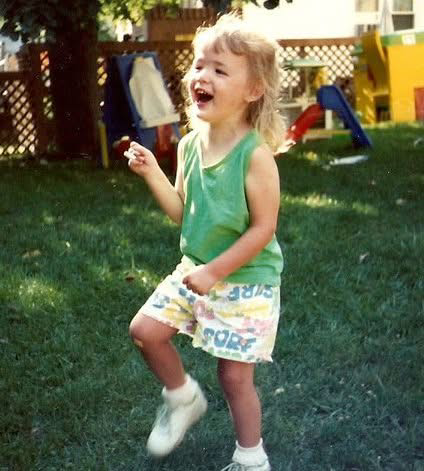
Go looking for a photo of yourself as a child. Something that feels alive. A moment where you can see yourself in it — really see yourself. Maybe you're playing, or laughing, or concentrating hard on something. Maybe you're somewhere you loved. Maybe you're just being unself-consciously, completely yourself in the way that children are before the world teaches them otherwise.
You'll know the right one when you find it. Trust that!
When you have it, set it somewhere you can really look at it. Your altar if you have one. The kitchen table. Somewhere with good light. Sit with it for a few minutes. Really look at her.
Notice what she looks like. What she's doing. What the expression on her face is. What she seems to be feeling in that moment.
And then sit with her for a few minutes. Think about what her life was life in that photo. What she liked to do. How she showed up. What she longed for.
Let whatever comes, come. She's been waiting to be consulted!
Then bring the photo with you on Wednesday. We're going to spend some time with her together!